Monetization
Strikethrough price anchoring on paywalls: 10 real examples
A crossed-out price can explain a genuine promotion or obscure what renews. Compare ten examples and learn to pair each reference price with an honest period.
Strikethrough pricing puts a reference amount next to the offer, typically crossed out so the new price stands forward. Used well, it answers “Compared with what?” Used poorly, it gives the cheaper number credibility without ever answering that question. A usual renewal price, a discounted first term, the total of monthly payments, and the cost of bundled products bought separately are not the same comparator.
These examples show what was displayed at capture time. They do not verify an app's full discount eligibility, historical list price, or legal compliance. Don't borrow a crossed-out number; borrow the structure only if your own billing and proof support it.
Compare the same term against the actual renewal
The Globe and Mail puts $2.99 USD per month beside $24.99 and explicitly names the first six months and the later monthly price. The New York Times displays different introductory periods for annual and monthly offers: a discounted first year on one, a discounted first six months on the other. The price reference belongs to the corresponding period. Giving both the same “save today” label loses the important distinction even when the numbers are correct.
The Sydney Morning Herald describes a three-month discounted period. A careful screen uses space after the offer amount to say what follows, rather than buying room for a badge. If the regular price and comparison are genuinely identical, “then $X/month” is clearer than an unexplained strike. If they differ, the visible text should say which is which. For additional in-app introductory offers, see subscription introductory offer examples.


Weekly offers should say which week
MonoBoost says explicitly that $0.99 applies to the first week and the $9.99 amount follows. StyleLab displays $6.99 per week next to $9.99 and calls the discount first-week-only in the heading. If the heading scrolls away, the sticky purchase button still needs to state the first paid and ongoing amount. You don't want a person arriving from a remote screen reader focus or scrolling straight to Continue to lose the essential qualifier.
The same writing works in receipts and reminders: “$0.99 for the first week, then $9.99 each week unless canceled.” There's no need to repeat a percentage if the existing amount, new amount, and duration are already readable. If you do include a percentage, compute it from the same localized period and round consistently. Don't carry percentages across storefronts with different localized price tiers.


Lifetime discounts and free trials are separate promises
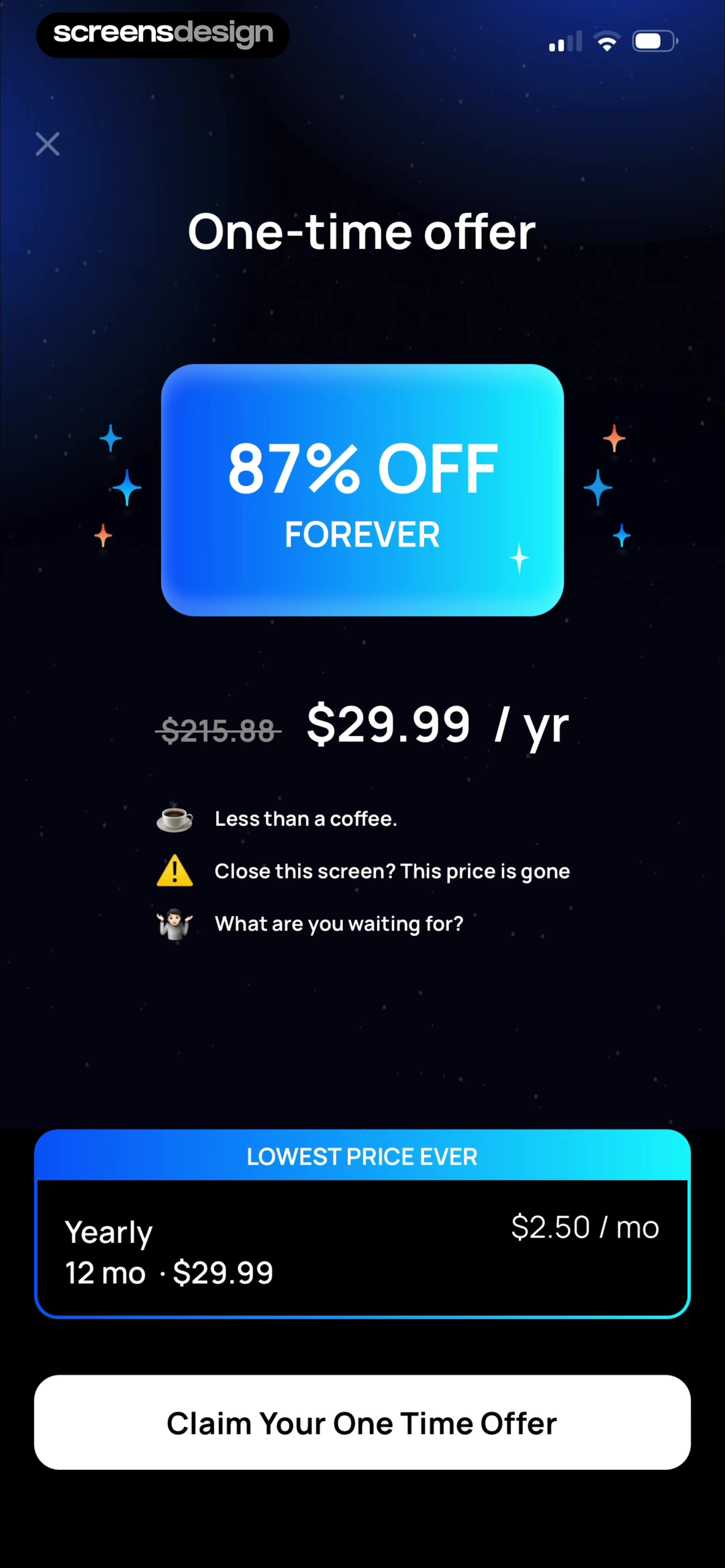
Word Swag promotes a monthly price reduction described as ongoing and also references a seven-day trial. Flo's recorded gift shows an annual offer different from its earlier trial path. Skillsta shows a trial followed by a discounted annual price plus a derived monthly equivalent. Each treatment layers at least two pieces of meaning. A good hierarchy tells you which amount is collected when the trial ends and what renews next. If “forever” merely means while a continuously active subscription retains the offer, explain that condition before purchase and test what happens after cancellation or a lapse.
For a paid switch from a free offer, let the user keep the free path if it is still available. State that choosing the new plan will charge now when that's what happens. Put no badge between the real decision and the confirmation. Compare free trial onboarding best practices when the first charge is not the next immediate action.


A bundle comparison is not the same as a former price
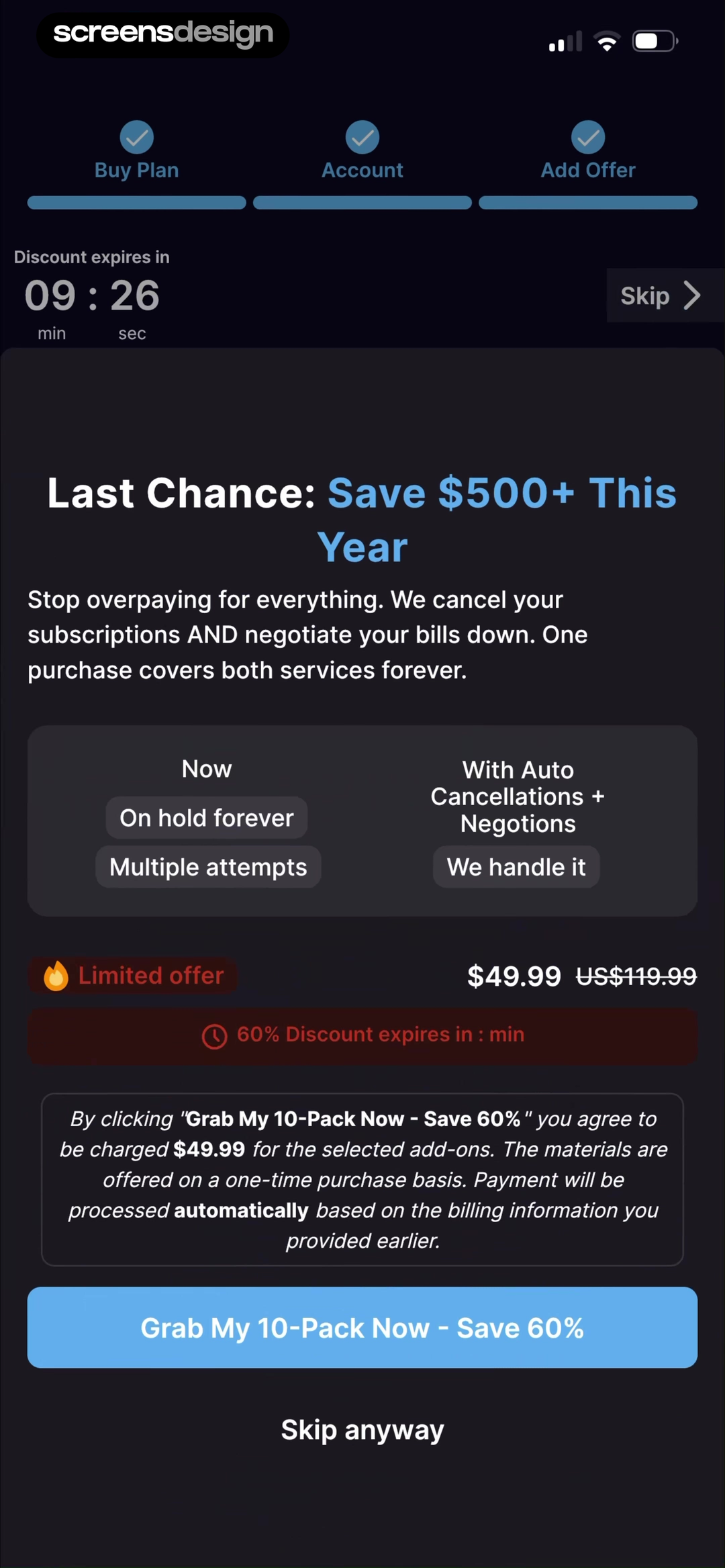
Subpilot's recorded example sells a pack, not an automatically recurring subscription. A struck-through reference there could represent a price for buying the components individually; the screen doesn't establish that basis. A pack should say “one-time purchase” when it is one, and show how its units are consumed. The same visual pattern on a recurring product needs a renewal. Never infer a renewal merely because another app uses similar typography.
Pushscroll shows a high crossed-out number and a lower annual amount. The interface does not independently prove that all users could buy the same annual plan at the reference price. If you're anchoring to the normal monthly plan multiplied by 12, call it “12 monthly payments” rather than labeling it an earlier annual price. If the entitlement differs between compared plans, show that too. In some cases “$29.99/year, billed annually” and a list of included features is more convincing without a reference number.
Represent the reference in the offer data
Avoid a single generic “old price” field. Use a type for regular renewal, historical price, same-access monthly comparison, or bundle sum. Couple it with source, currency, comparison period, promotion duration and last verified time. If the source expires or hasn't been confirmed in a storefront, fail to a plain current price, not a mysterious strike. Format the old and new prices as text with meaningful accessible names: line decoration alone can't explain their roles.
Check the pricing paths with real transitions: initial view, switching plan, eligibility refresh, cancellation, refund, and relaunch as a returning subscriber. If an app store update changes the actual amount, don't let a local percent badge lag behind. Apple's review guidelines cover subscription disclosures; a review checklist is not legal advice or a replacement for validating your actual offers.
Worked example: compare an annual subscriber with twelve monthly payments
Suppose both plans unlock the same features. Monthly costs $8 and annual costs $60. Twelve paid monthly bills add up to $96, so $60 is $36 lower under that specific scenario. A defensible label is “$36 less than 12 monthly payments.” A crossed-out “$96/year” is less clear because the product might never have offered a $96 annual renewal. If the actual former annual price was $72, that's a separate comparator. Don't use the same “was” strike for both.
Now introduce a $40 first year that renews at $60. Write the primary line as “$40 for the first year, then $60/year.” This compares the same billed interval honestly and communicates the decision in reading order. To offer someone $96 as additional context, state its premise specifically and put it below the charge terms. If the monthly offer includes features that annual does not, drop the $96 comparison until you can compare like for like. When upfront spend matters to the person, two real first charges can be more useful than a percentage.
Validate the English and localized texts when more than one amount is visible. The phrases “formerly” and “renews at” aren't interchangeable. Some currencies need more space and some languages place the unit differently. The price can be a single accessible phrase like “40 dollars for the first year, then 60 dollars per year.” Line decoration can remain as a visual aid. Do not screen-read “96 dollars” and then “60 dollars” in an order that loses the explanation just because one span has CSS decoration.
Evaluate with a test user who refuses the offer, then returns after it ends and after changing plans. Ask them to identify the comparison, expected payment, and next charge. A stakeholder who explains the comparison out loud during the test is accidentally testing their explanation, not the screen.
Keep a record of what a customer actually saw around checkout when that's appropriate for support: which offer identity and renewal period were presented, not just a screenshot of your current default. If they ask why the first charge differs, support should be able to distinguish stale display metadata, an ineligible promotion, and an authentic change to the selection. Test the situation where the app returns from a declined storefront sheet with no updated price. Don't keep the dually priced “old” and “new” screen alive on the assumption that it must still be true. Refresh, preserve a sensible close route, and let the person decide again against the real offer.
A price anchor checklist
Run these checks on a working build.
- Say what the reference represents: regular renewal, previous charge, comparable term, or comparable bundle.
- Show promotional period, actual collected amount, and post-promo renewal together.
- Test the text alone with no badges, color, or strikethrough.
- Validate price and eligibility after changing storefronts.
- Remove the anchor if you cannot establish its basis.
Questions and answers
Frequently asked questions
Can I cross out the monthly equivalent?
A derived equivalent is usually weak as the primary comparator. If you compare periods, label the actual term and the basis of the comparison instead of making the equivalent look like an original billed price.
Is a strikethrough required for a discount?
No. “$2.99/month for six months, then $24.99/month” communicates the transaction without relying on decoration.
What if a plan has no regular renewal?
State the actual first payment and purchase type. If it's a prepaid pack, explain what expires or runs out, not an invented subscription renewal.
Apps referenced in this page
Open the products behind the examples.
 The Globe and MailNews from Canada and the World
 NYTimes: US and World NewsBreaking News and Live Updates
 The Sydney Morning HeraldView recorded app flows
 MonoBoost Cancel SubscriptionsSubscription Manager & Stopper
 My Color Analysis・AI StyleLabSeason palette & outfit maker
 Word Swag - Cool FontsPoster, flyer & quote maker
 Flo Cycle & Period TrackerOvulation & Pregnancy Calendar
 Skillsta: Life Skills TrainerCharisma, Confidence & Growth
 Subpilot - Cancel SubscriptionFind & stop unwanted charges
 Pushscroll: Exercise To ScrollWorkout to Earn Screen Time
2,958 apps in the top charts.Ask them anything.
Use ScreensDesign Pro to look beyond a single paywall. Compare how apps introduce offers, explain renewals, and help users return after checkout.