Free trial onboarding
Free Trial Onboarding Best Practices: 10 Recorded Examples
People should understand what begins today, when a reminder arrives, when payment starts, and what they can meaningfully evaluate before then.
Free trial onboarding has two jobs. It must disclose the commercial timeline clearly, and it must lead the user into a product task that can demonstrate value within that time. A polished three-step timeline is weak if the price is hidden or the first useful action remains unclear.
This review examines ten exact recorded screens from ten apps. The evidence covers three-day and seven-day trials, configurable reminders, product-specific value, charge dates, annual pricing, and cancellation language. It does not measure trial conversion or subscriber retention.
For the pricing screen itself, compare the mobile app paywall design examples.
01. Trial timeline
Put today, reminder, and first charge on one timeline.
The user should not need to calculate what happens next.
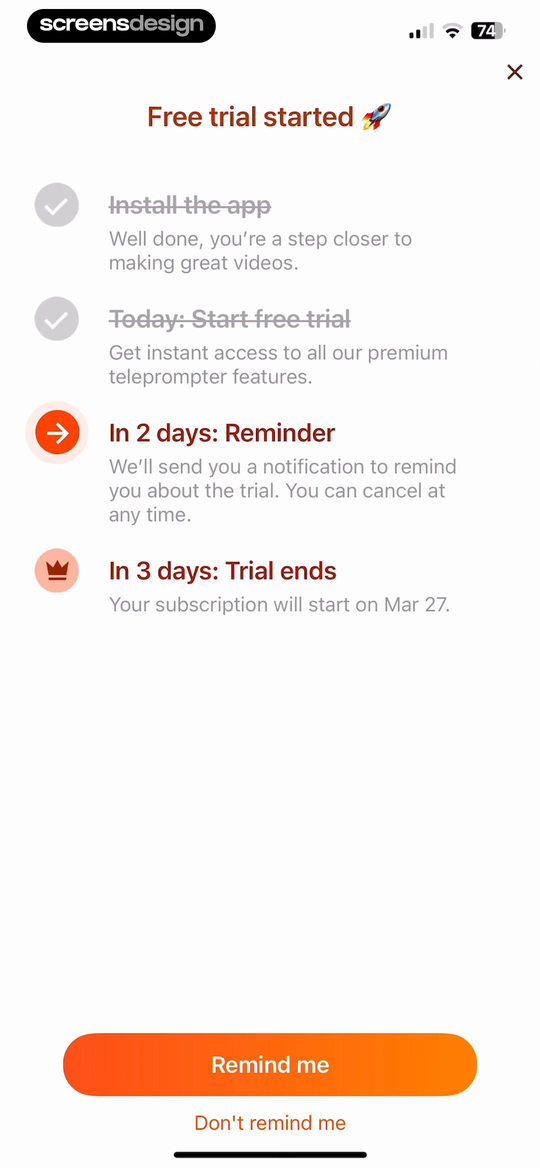
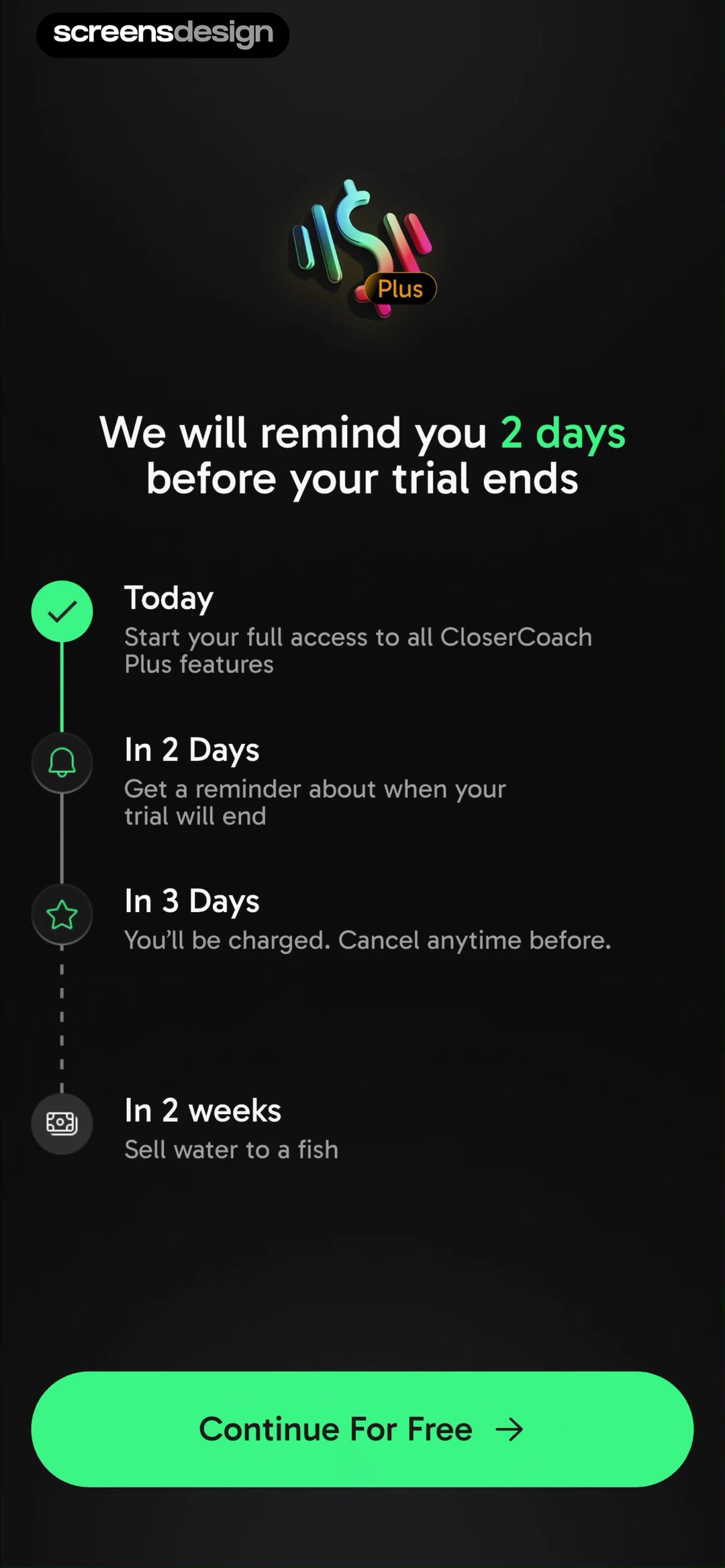
Teleprompter for Video shows trial start, a reminder in two days, and subscription start in three days. CloserCoach uses the same structure and adds a concrete future practice outcome. Both make the sequence visible before Continue.
Use absolute dates where possible, especially near month boundaries. State trial length, reminder date, charge date, price, billing period, and cancellation cutoff. Do not rely on after seven days if the platform may charge earlier under its billing rules.
Test late-night starts, timezone changes, restored trials, people who already used an introductory offer, and prices that include tax. The timeline must come from the actual purchase product and eligibility state.
02. Price before start
Keep the paid consequence beside the trial action.
Free describes the first period, not the entire agreement.
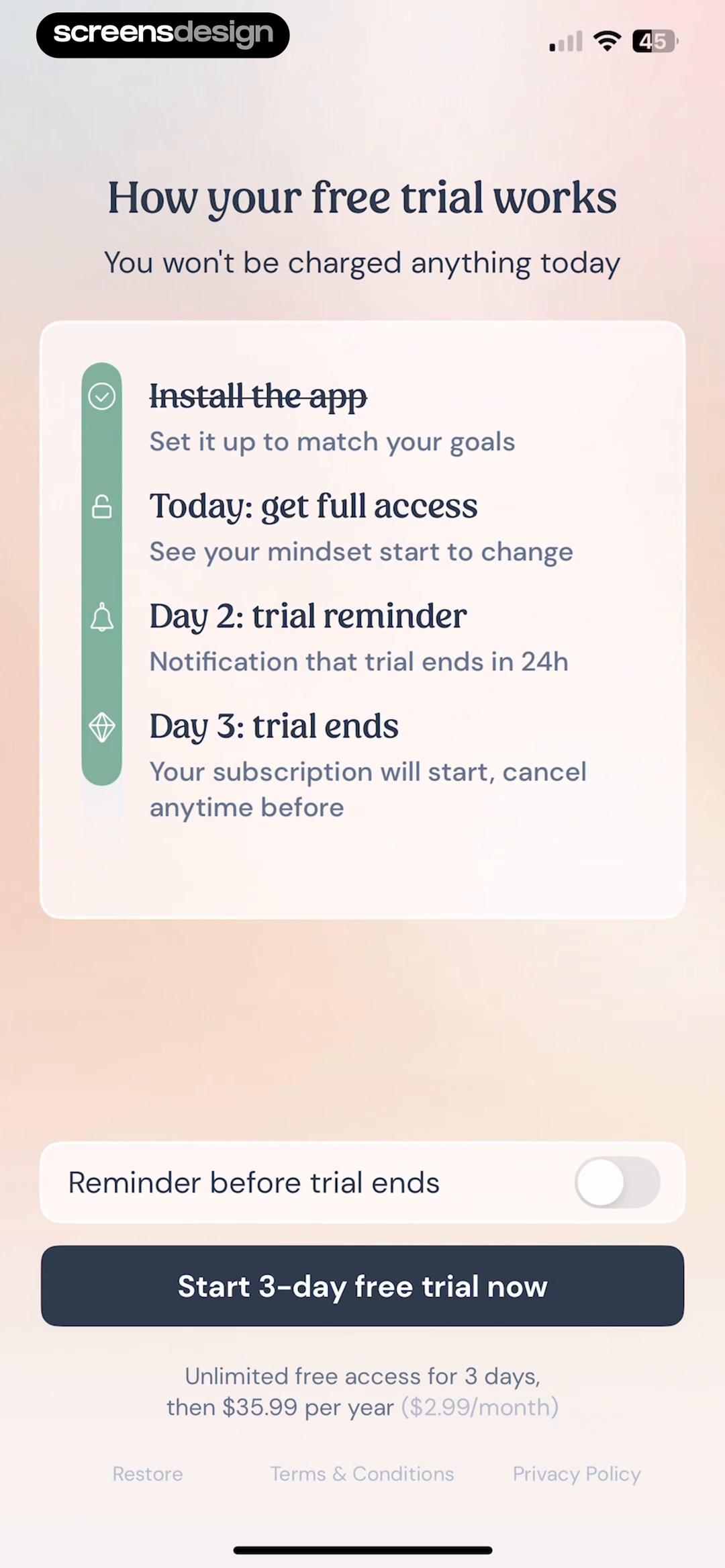
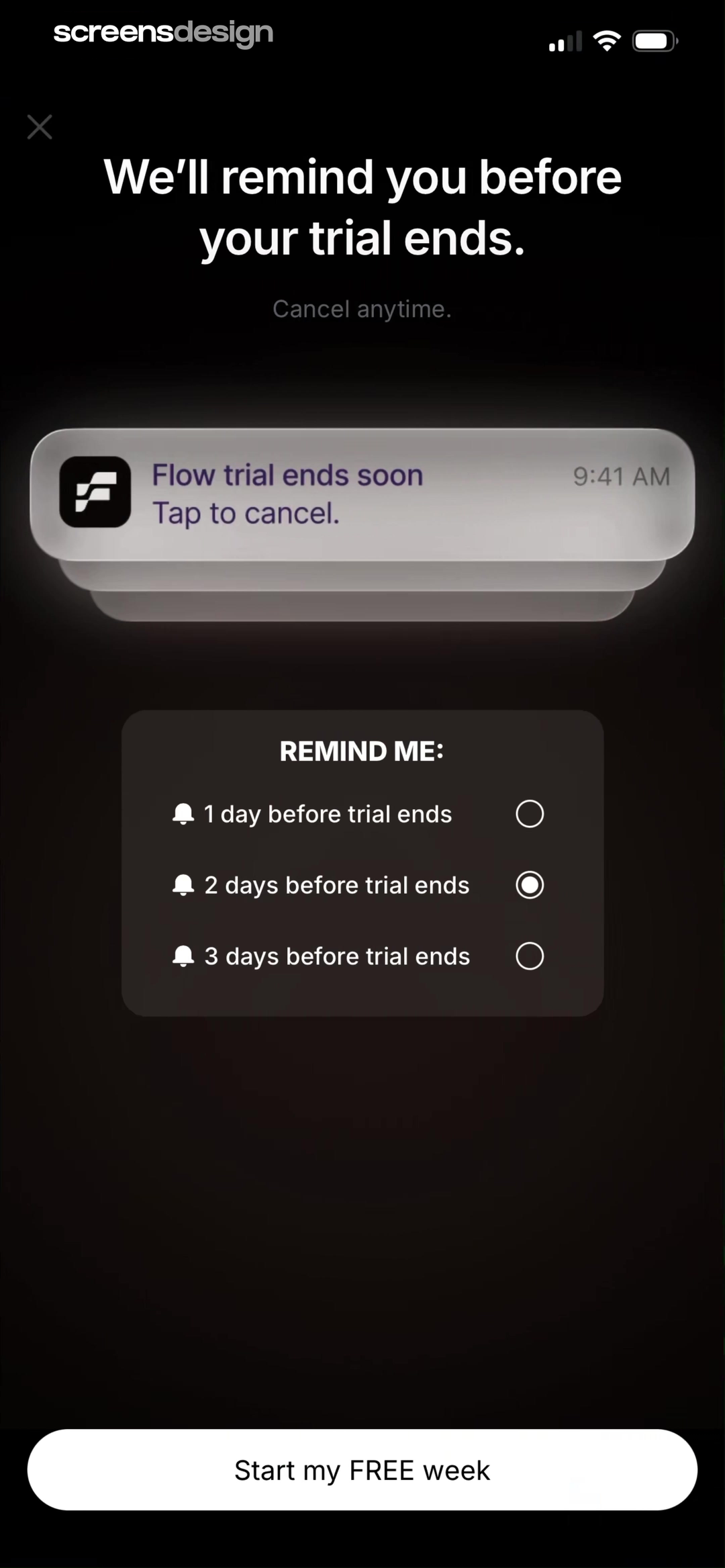
I am shows no charge today, full access, reminder timing, trial end, and the annual price beside the start action. Flow lets users choose whether the reminder arrives one, two, or three days before the trial ends.
Place total price and billing period near the trial button. Effective monthly price can support comparison, but it should not replace the amount actually charged. Explain automatic renewal in ordinary language.
Avoid styling that gives Free much greater prominence than the later price. Verify dynamic type, localization, and smaller screens so the charge does not fall below a clipped scroll area.
03. Reminder choice
Make the promised reminder configurable and real.
A reminder claim should correspond to a notification the product can actually send.
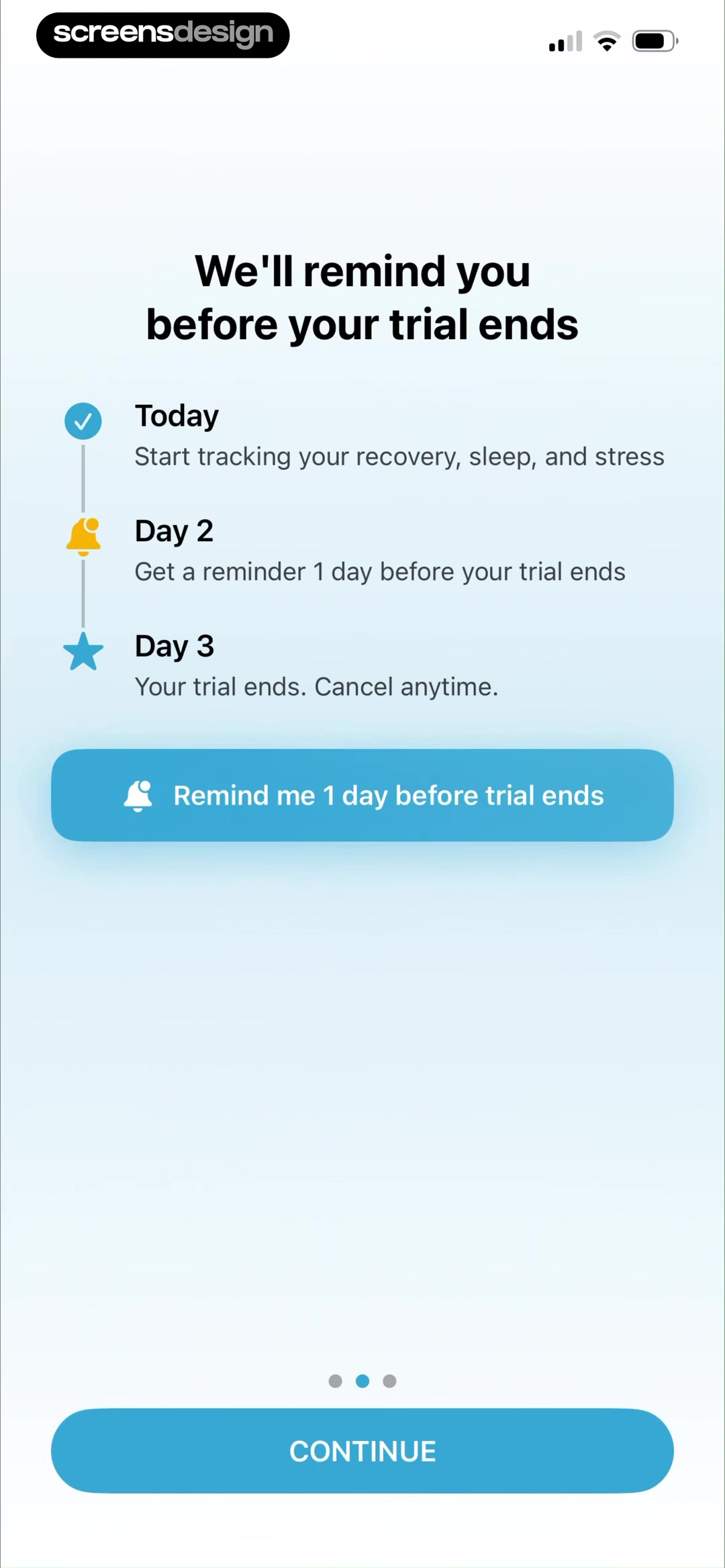
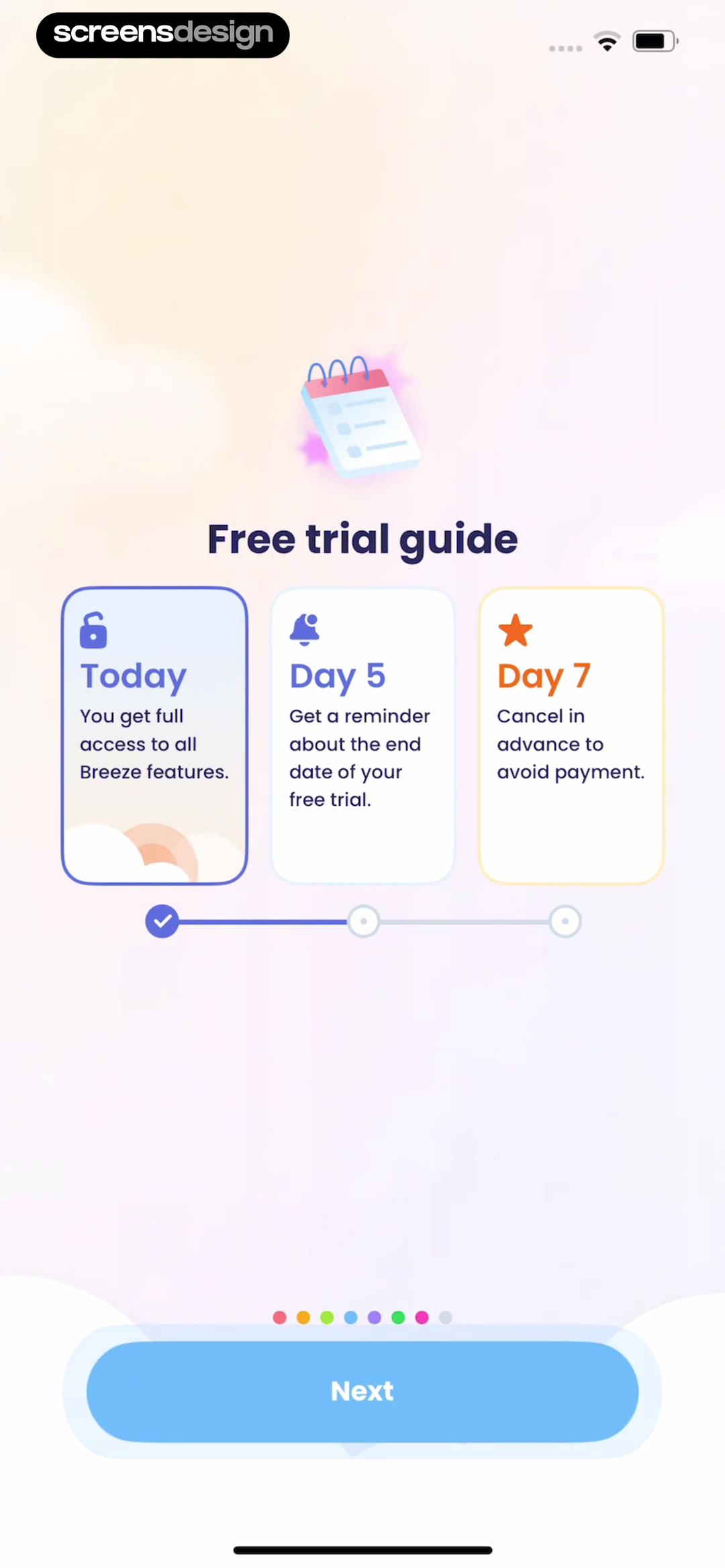
Livity connects recovery, sleep, and stress tracking to a Day 2 reminder and Day 3 trial end. Breeze states full access today, an end-date reminder on Day 5, and the need to cancel before Day 7.
Ask for notification access only after the reminder benefit is explained. Let users choose the channel or decline when possible. Show the reminder setting later in subscription management and handle denied notification permission honestly.
A reminder is not a substitute for clear billing disclosure. Test notification delivery, email fallback, quiet hours, disabled permissions, and a subscription canceled before the alert fires.
04. Value during trial
Name the outcome the user can test before payment.
A trial needs an achievable path to evidence, not unlimited access in the abstract.
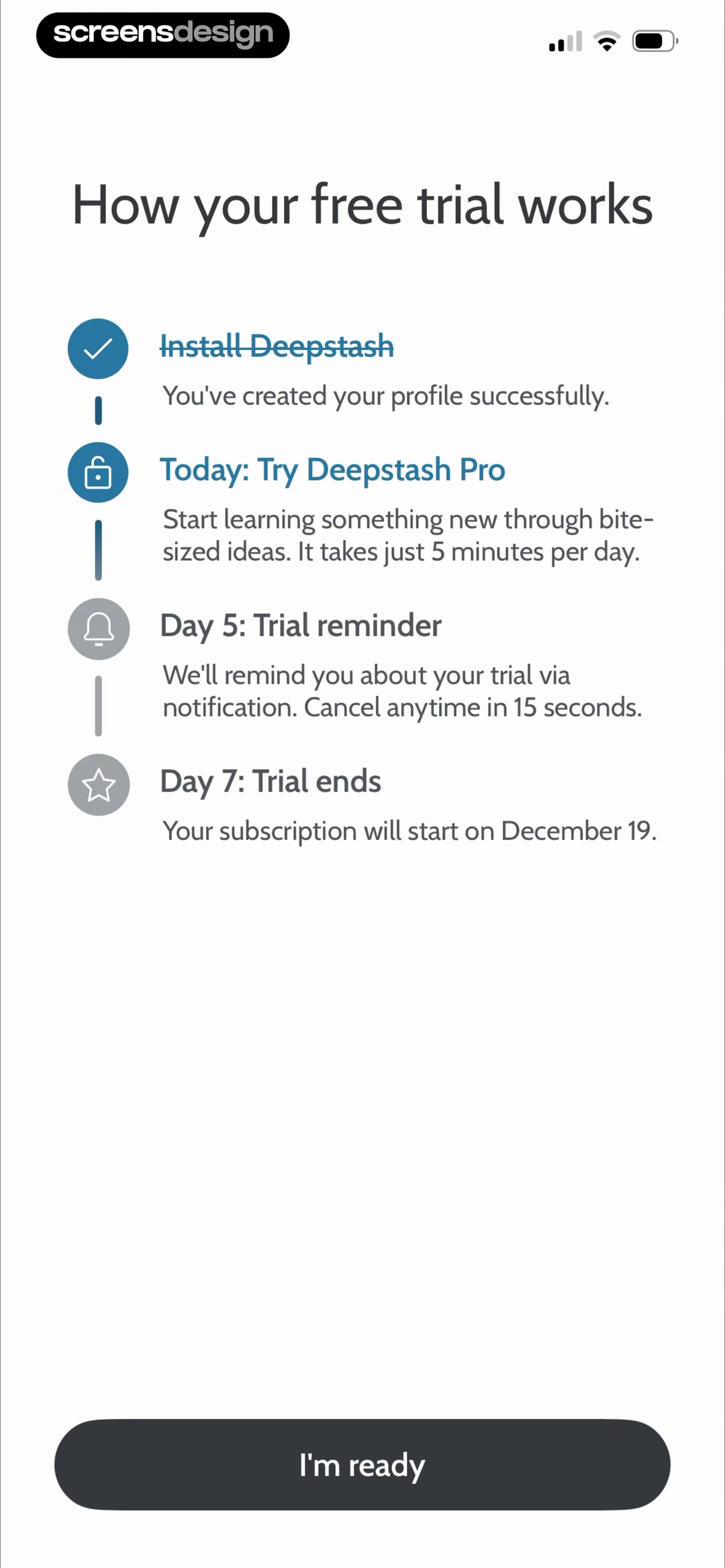
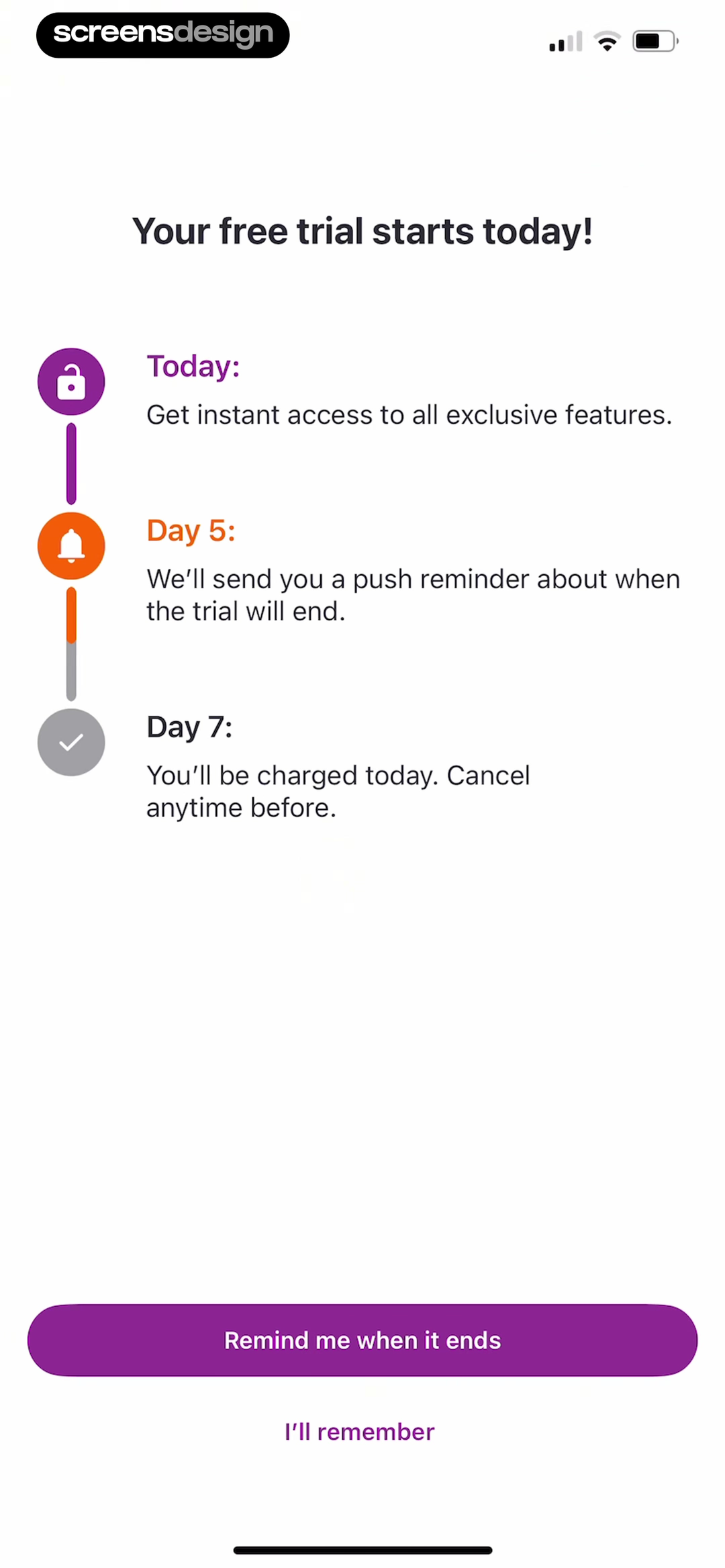
Deepstash frames its seven-day trial around five minutes of daily learning. Moovit promises access to its exclusive features and states the Day 5 reminder and Day 7 charge. The better direction is to connect those features to a first route, saved commute, or removed interruption.
Set up the first valuable task immediately after purchase. Use the trial length to pace activation, not to bombard users with every premium feature. Show progress toward an outcome the product can observe without implying guaranteed life improvement.
If the first value depends on data accumulation, explain that before purchase and offer a sample or preview. A three-day trial should not promise an insight that requires several weeks of history.
05. Cancellation and conversion
Explain cancellation before the user needs it.
A clear exit builds trust in the start decision.
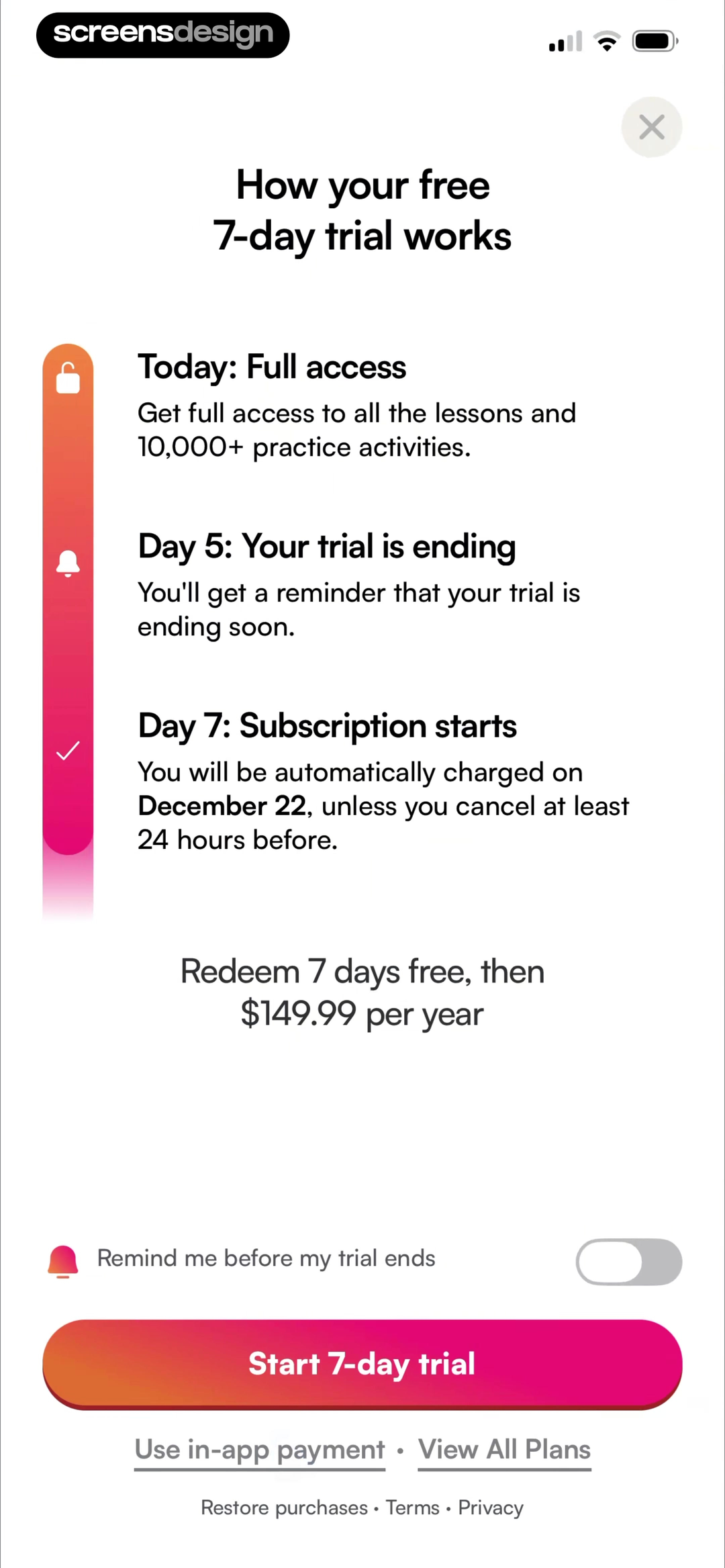
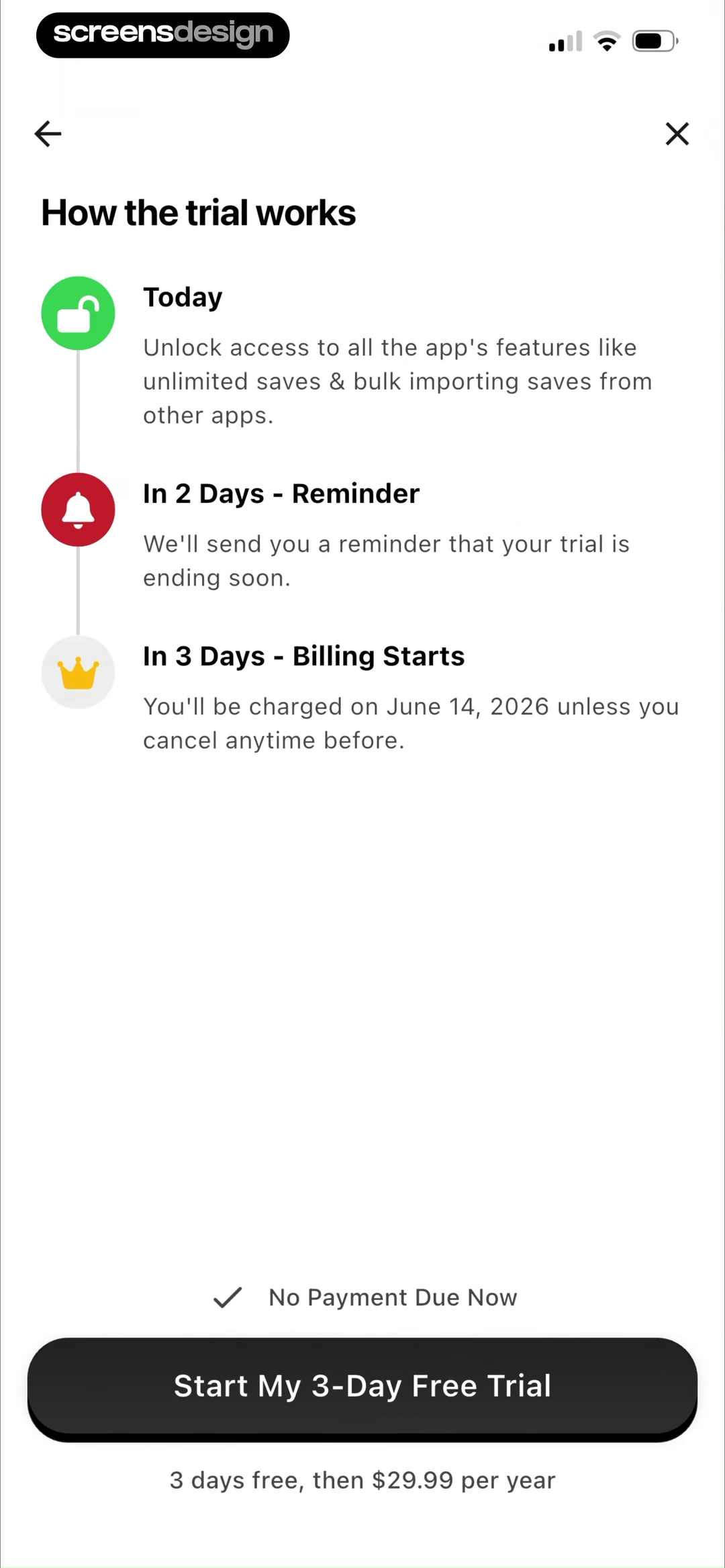
BoldVoice states the full-access period, Day 5 reminder, Day 7 annual charge, cancellation cutoff, and exact annual price. Albo names the unlocked saving features, reminder day, billing-start date, annual price, and no-payment-due-now state.
Provide a direct explanation of how to cancel and where billing is managed. Keep View all plans, Restore, Terms, and Privacy available without competing with the primary decision. After trial cancellation, state the access end date.
Test canceled-but-active access, failed billing, grace periods, refunds, plan changes, and a user who deletes the app. Never imply that uninstalling ends the subscription. ScreensDesign Pro can help teams inspect what happens before and after the trial screen across complete recordings.
Trial lifecycle
Build trial onboarding around value, time, and billing.
The user needs to know what to try, how much time remains, and what happens financially without hunting through settings.
Define the activation event for the product before designing a trial checklist. It should represent real value, such as completing a workout, exporting a result, finishing a lesson, or collaborating on a project. Account creation, notification permission, and profile completion may support that outcome, but they are not substitutes for it. Put the shortest credible route to activation first and defer optional setup.
Treat the trial as a changing state. The first session should explain the promised capability and lead into use. The middle should restore unfinished work and surface relevant features without resetting onboarding. The final days should show the end date, renewal price, billing interval, and management route in plain language. If a reminder is promised, confirm when it will arrive and handle denied notification permission honestly.
Test trial eligibility, previous trials, redeemed offers, family sharing, restore purchase, billing grace, refunds, plan changes, and time-zone boundaries. The interface must not advertise a trial that the store will reject. If eligibility cannot be known before the store sheet, phrase the offer conditionally and let the system purchase UI remain authoritative.
Align the purchase surface with the mobile paywall examples, then carry the same dates and terms into the renewal reminder flow.
- The checklist leads to product value rather than administrative completion.
- Trial end date, renewal price, and billing interval use consistent language.
- Returning users resume their trial state instead of seeing first-run onboarding again.
- Ineligible, expired, restored, and billing-grace accounts have tested paths.
- Activation, retained use, renewal, cancellation, refund, and support outcomes are reviewed together.
Measurement
Read trial performance as a sequence of value and consent.
A trial is not healthy merely because many people start it or fail to cancel before renewal.
Track eligibility, trial start, activation event, meaningful repeat use, reminder delivery, plan-management views, renewal, cancellation, refund, and support contact. Break these down by offer, duration, acquisition source, platform, and previous purchase state. This reveals whether a strong start rate came from real intent or from an offer users did not understand.
Use time-to-value and retained use as product measures, then keep billing clarity as a guardrail. Review trial-end confusion, accidental renewal reports, notification opt-outs, failed restore attempts, and users who reach the paywall again while already entitled. A successful onboarding should reduce uncertainty as well as increase product use.
For experiments, preserve identical price, eligibility, and renewal facts. Test ordering, guidance, reminders, and continuation paths without obscuring terms. Compare the complete trial window and at least one post-renewal period, because an intervention can lift early activation while producing later cancellations or refunds.
Review checklist
Test the trial as a timed product state.
Create eligible, ineligible, trialing, canceled, converted, expired, billing-failed, and restored accounts. Confirm the timeline, price, reminder, purchase product, and access state for each.
Follow the first action after purchase and verify that it can demonstrate the promised capability within the trial. Check reminder delivery and cancellation instructions on every supported billing platform.
- Trial length and eligibility match the purchase product.
- No-charge-today language is accurate.
- Total price and billing period appear near the start action.
- Reminder date and channel are stated.
- Notification permission follows the reminder explanation.
- The first paid task is reachable immediately.
- Cancellation instructions name the billing owner.
- Canceled trials retain access only for the promised period.
Questions and answers
Free trial onboarding questions
What should a free trial screen show?
Show what starts today, trial length, reminder date and channel, first charge date, total price, billing period, automatic renewal, cancellation cutoff, and the first useful paid task.
When should an app ask for notification permission during a trial?
Ask after explaining a specific trial reminder and allowing the user to understand or configure it. Denied permission must not hide the billing timeline.
Should a free trial show the annual price?
Yes. If the user will be billed annually, show the total annual charge. An effective monthly equivalent can appear as supporting information.
How can a trial demonstrate value quickly?
Route the user to one achievable paid outcome, preserve setup, and show relevant progress. Do not introduce every premium feature before the first task.
Does deleting an app cancel a free trial?
Usually no. The interface should direct users to the billing platform or account surface that owns cancellation and state when access will end.
Apps referenced in this page
Open the products behind the examples.
 Teleprompter for VideoRead script, record & caption
 CloserCoachObjection Handling Coach
 I amPositive widgets & motivation
 FlowThe alarm you can't ignore
 LivityWatch, Workout & Heart Rate
 BreezeRoutine, Tests, Insights, Calm
 DeepstashBite-sized Knowledge & Books
 MoovitMetro Stop Finder, Train Times
 BoldVoiceSpeak English, Pronunciation
 AlboBookmark reels & screenshots
2,715 apps in the top charts.Ask them anything.
Search real app flows, compare the screens around each decision, and turn stronger references into your own product.