AI photo editor paywalls
10 AI Photo Editor Free Trial and Paywall Examples
The customer should know what they are buying and what will happen to the image already in progress.
AI photo editors can charge for access, generation capacity, faster processing, higher-resolution export, watermark removal, premium models, templates, or a combination of them. Those are different products. A screen that mixes a recurring subscription with consumable credits and export rules without explaining the boundaries makes comparison nearly impossible.
These ten recorded screens show annual and weekly subscriptions, free trials, credit packs, feature tables, watermarks, model access, and creative limits. The examples are especially useful because the purchase often interrupts a real edit. That means the commercial experience includes the source image, prompt, generation state, result preview, and the route back after any purchase outcome.
Start by naming the constrained action in plain language. Then show whether the plan removes a limit, replenishes a balance, unlocks a model, or changes the exported file. Keep trial timing, billed total, renewal, restoration, and any remaining usage visible. A premium label is not a substitute for the entitlement model.
For the first-edit journey before payment, study the AI photo editor onboarding examples.
01. Credits and access
Separate recurring access from consumable generation credits.
A subscription and a credit pack answer different usage problems.
LightX offers a defined number of credits and connects them to watermark-free AI creation. Halo AI presents credit packs after the customer asks to keep transforming a photo. Both make the unit visible, but a useful purchase screen must also explain what one credit buys and whether a failed generation is returned.
If subscribers receive credits, show the included amount, reset date, rollover policy, top-up compatibility, and what remains available at zero. If credit packs expire or are limited to certain models, say so before purchase. Do not describe a pack as unlimited access when it funds only a finite number of generations.
Preserve the source image, prompt, mask, crop, selected style, and result history while the store sheet opens. When payment succeeds, resume the requested transformation instead of dropping the customer on a generic home screen. When it fails or is cancelled, return to the same edit with the original state intact.


02. Trial terms
Keep the free edit and the future charge in the same frame.
The action should not be visually louder than the commitment it creates.
Photo Editor offers three days free followed by a weekly subscription and names ad and watermark removal among the benefits. Art Pics states the same trial length and weekly renewal while previewing face effects and wallpapers. Each screen gives the customer a usable starting point for checking both access and price.
Add the exact trial duration, first billed amount, cadence, renewal behavior, and cancellation route near the button. If the app can send a trial reminder, expose a real preference and explain the delivery channel. A trial started previously, a different storefront, or an ineligible account needs a truthful alternate state rather than stale free-trial copy.
Photo products often show a low weekly price because usage feels immediate. That cadence can still create a substantial annual cost, so the screen should not hide it behind tiny disclosure. Make the full commercial meaning available in normal reading order and to assistive technology, then let the store confirmation verify the current localized product.


03. Result ownership
Explain export quality, watermarks, and saved work separately.
Unlock all features says little about the file a customer can keep.
AI Marvels lists faster processing, VIP templates, watermark-free saving, and ad removal. GenPix names unlimited creation, watermark removal, and background removal alongside annual and monthly terms. These screens connect price to recognizable editing and output capabilities rather than only calling the plan premium.
Define whether free users can preview, save a draft, export at reduced resolution, or return later. A watermark rule should say where the mark appears and whether purchasing removes it from an existing result. If higher resolution or commercial use is paid, present those entitlements independently so a customer does not infer rights the plan does not provide.
Do not delete a generated result when the customer declines. Save enough state to resume safely, while respecting retention and privacy settings for uploaded images. If cloud storage is itself a paid benefit, distinguish local draft continuity from long-term synchronized storage. The paywall should not create surprise data loss.


04. Benefit proof
Show the kind of result and the conditions around it.
A transformation preview is useful when it represents a capability the selected plan really includes.
Photo Lab foregrounds detailed generation, a large photo-pack library, ad removal, video creation, and output quality. BeautyPlus uses a before-and-after composition, names AI effects, and shows a seven-day trial followed by a twelve-month subscription expressed monthly. The result preview gives the benefits a concrete visual anchor.
Use a real class of output the user can reproduce, not a polished result that depends on an undisclosed model or separate credit purchase. Label premium models, processing queues, resolutions, and generation limits. If the product rotates templates or effects, avoid fixed counts that the entitlement catalog cannot maintain.
Testimonials and ratings can answer uncertainty about workflow, but they cannot prove that a particular paywall causes more purchases or that every generated result will match the preview. Attribute customer statements, keep current source data, and leave billing terms in the same hierarchy as the creative promise.


05. Plan structure
Use tiers only when they map to different creative workloads.
Model quality, credits, speed, and export rules need comparable units.
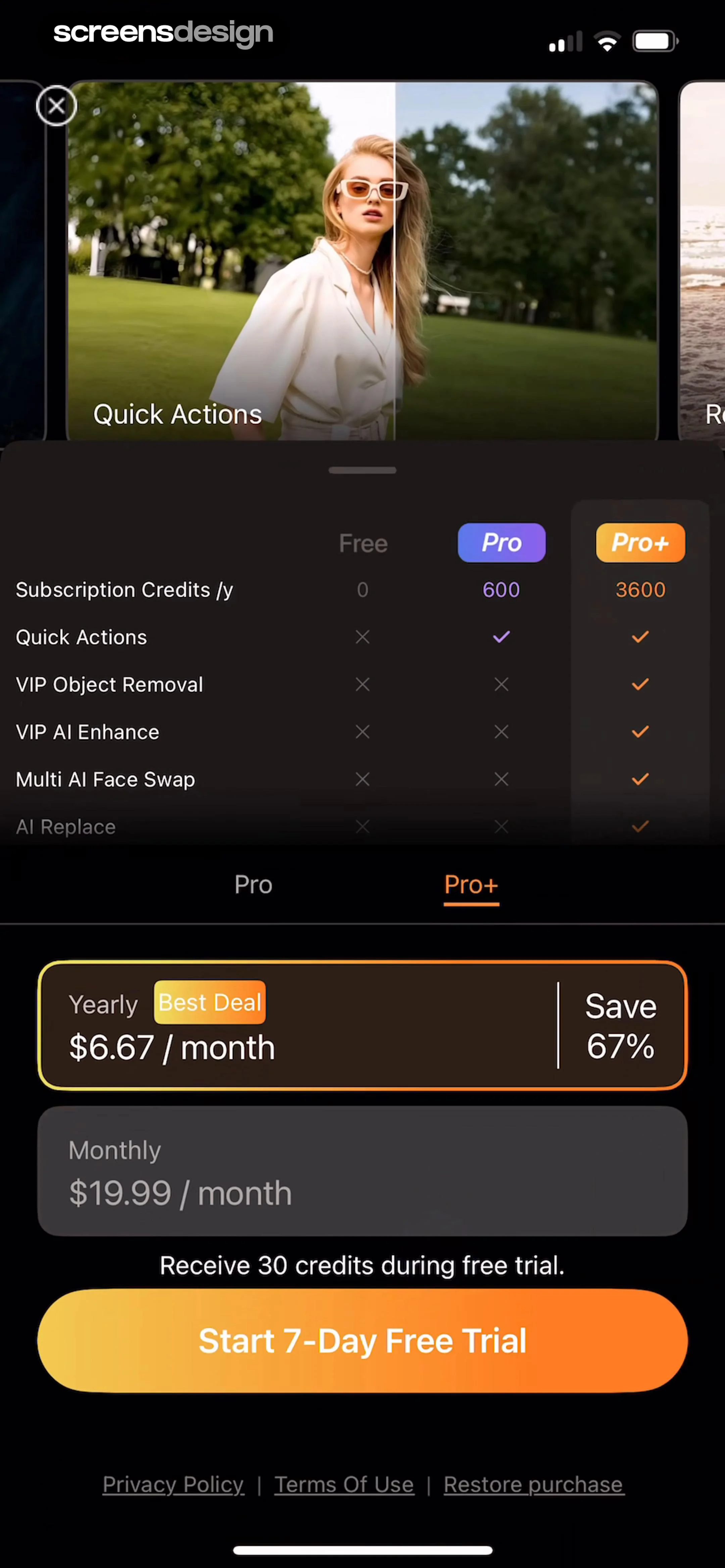
PhotoDirector compares Free, Pro, and Pro+ across annual subscription credits and named AI tools. AI Maker separates Plans and Credits, presents a credit quantity, and marks one subscription as popular. Both show the complexity that appears when access level and consumable capacity coexist.
A comparison should answer whether the higher tier adds models, increases monthly credits, removes a queue, improves resolution, or changes licensing. Keep billing term separate from access tier. If people can buy credits without subscribing, show that route and explain whether a subscription is still required to spend them.
Recommended and popular labels need a reason the customer can assess. Prefer a workload statement such as best for frequent weekly generation over an unsupported popularity claim. Preserve the chosen tier while billing cadence changes, and repeat the billed total at confirmation.

Implementation
Treat every edit and purchase as a recoverable state machine.
Creative continuity depends on the media pipeline and the billing system agreeing.
Persist a safe project reference before presenting payment. The project model should record source assets, prompt, model, parameters, mask, crop, output state, credit estimate, export request, and retention policy without copying sensitive media into analytics. The offer model should record product identifier, storefront price, term, trial eligibility, credit allowance, reset, watermark, resolution, queue, and restore behavior.
Define loading, generation queued, generation failed, result ready, export blocked, low balance, zero balance, product unavailable, purchase pending, store sheet cancelled, purchase verified, verification delayed, and restore states. A retry must not charge credits twice. A late generation should reconnect to the project even if the app was closed during purchase.
Test large images, unsupported formats, network loss, content-policy rejection, backgrounding, low storage, duplicate store callbacks, family sharing, a subscription bought elsewhere, and refund or expiry. Accessibility review should cover selected-plan announcements, long localized prices, contrast over preview imagery, dynamic type, and alternatives to motion-only before-and-after demonstrations.
- Subscription access and consumable credits are explained separately.
- Watermark, resolution, storage, and export rules are explicit.
- The source image and edit survive cancelled and failed purchases.
- A failed generation does not consume credits twice.
- Localized price and store confirmation match the selected product.
- Restore and existing-subscriber routes are visible.
Measurement
Measure whether paid access completes the edit.
Trial starts and credit sales are incomplete without a usable result.
Track the paywall entry action, project state, product displayed, selected model, estimated credit cost, store sheet outcome, receipt verification, entitlement or balance update, resumed generation, successful export, restore result, and error. Use privacy-safe identifiers and avoid logging source images, faces, prompts, or generated content unless the person has explicitly chosen a supported diagnostic path.
Segment by entry point, model, export type, prior successful result, remaining credits, trial eligibility, storefront, and device capability. Review guardrails such as repeated purchase attempts, abandoned edits, failed exports, refund, cancellation, support contact, generation rejection, and unexpected credit deductions. Do not treat revenue or a visible screen pattern as proof that the interface caused better conversion.
The most informative review often follows the original edit across sessions. Check whether a customer who pays can locate the result, reproduce the promised capability, understand remaining capacity, and manage the plan. A higher checkout rate with more lost projects is not a healthy improvement.
Review checklist
Test the offer from source image to exported file.
Run a free user, trial-eligible user, returning subscriber, expired subscriber, credit buyer, and restored purchaser through the same edit. Compare the visible promise with the actual model, queue, credits, result, watermark, and export.
Repeat with a failed generation, cancelled store sheet, delayed verification, offline return, large text, screen reader, reduced motion, and a long localized price. Every outcome should preserve a safe project and explain the next available action.
- The offer names the action that triggered it.
- Every credit quantity maps to a documented workload.
- Trial and renewal terms remain near the primary action.
- The result can be resumed after payment or dismissal.
- The export matches the promised quality and watermark state.
- Sensitive creative content stays out of routine analytics.
Questions and answers
AI photo editor paywall questions
Should an AI photo app sell subscriptions or credits?
Use subscriptions for recurring access and credits for measurable consumption. If both exist, explain included credits, resets, top-ups, and whether a subscription is required.
When should the app show the paywall?
After the person understands the requested transformation or reaches a clearly stated limit. Preserve the source and edit through every purchase outcome.
What should a free trial disclose?
Show the trial length, first charge, full billed amount, cadence, renewal, cancellation route, eligibility, and restore option near the action.
How should watermark removal be described?
State whether it applies to preview, export, existing results, and each resolution. Keep watermark rules separate from storage and commercial-use rights.
What is the most important post-purchase action?
Verify access or credits, then resume the exact edit, generation, or export that led to the purchase.
Apps referenced in this page
Open the products behind the examples.
 LightX: AI Generator & EditorCrop Photo & Background Eraser
 Halo AI: Photo & Video EditorAI Photos, Videos & Pranks
 Photo EditоrPhoto Collage Maker: AI Editor
 Art Pics-Photo Editor&FaceSwapCartoon Aging&Live Wallpapers
 AI Marvels - AI Photo & VideoDance Generator&Anime Filters
 GenPix - AI Photo EditorGenerative fill and expand
 Photo Lab - AI Image EditorViral Stadium Live Camera FX
 BeautyPlus-Selfie Photo EditorSeamless Collage & Crowd Cam
 PhotoDirector: AI Photo EditorPhoto to Video, Try-On, AI Art
 AI Maker: Photo Video FiltersViral Dance & Birthday Shoot
2,805 apps in the top charts.Ask them anything.
Compare recorded AI photo editor paywalls, inspect complete edit and purchase flows, and study how apps explain trials, credits, watermarks, and exports.